


Genocide Intervention Network
Our Task
Nonprofit Website Design Task
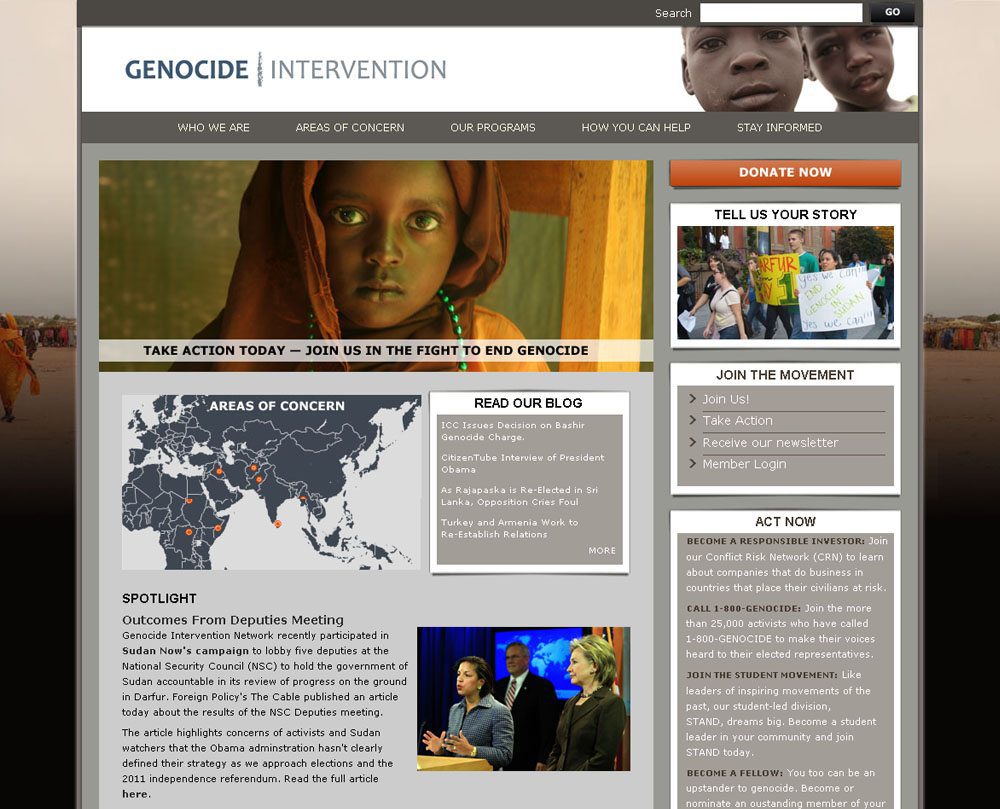
Genocide Intervention Network needed a new brand and website for a global anti-genocide organization working to help people understand, prevent, and respond to mass atrocities. The project required a visual identity that could carry a serious public mission, support national advocacy, and give staff, supporters, students, fellows, partners, and concerned citizens a clear way to learn about the organization’s work.
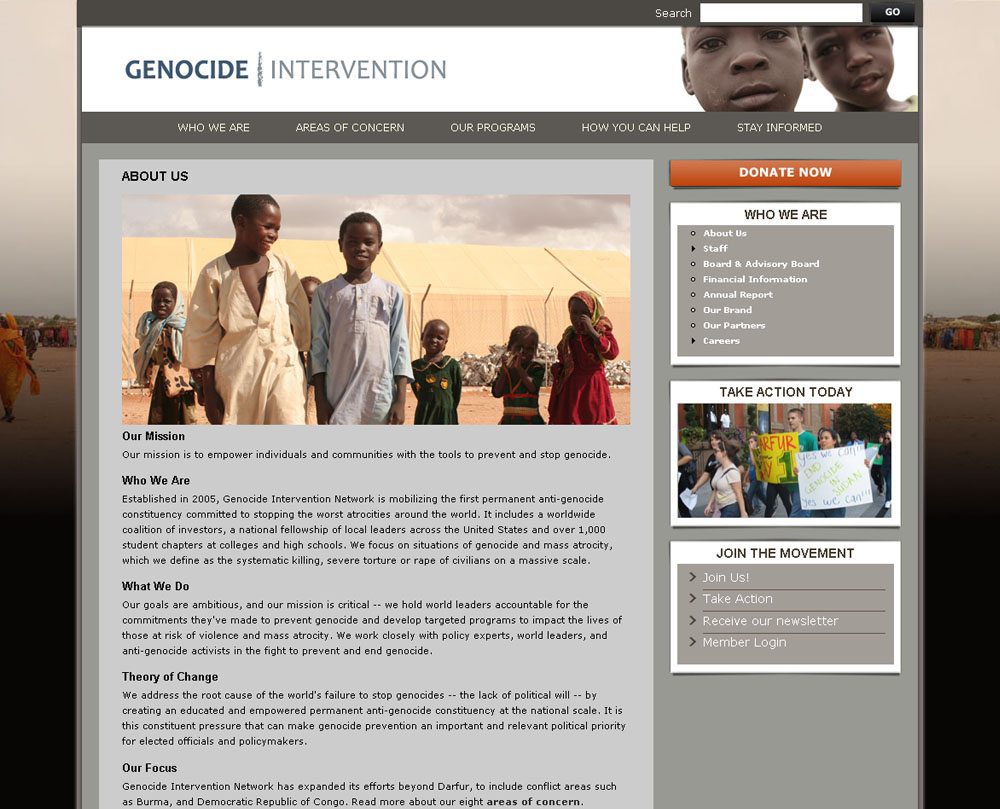
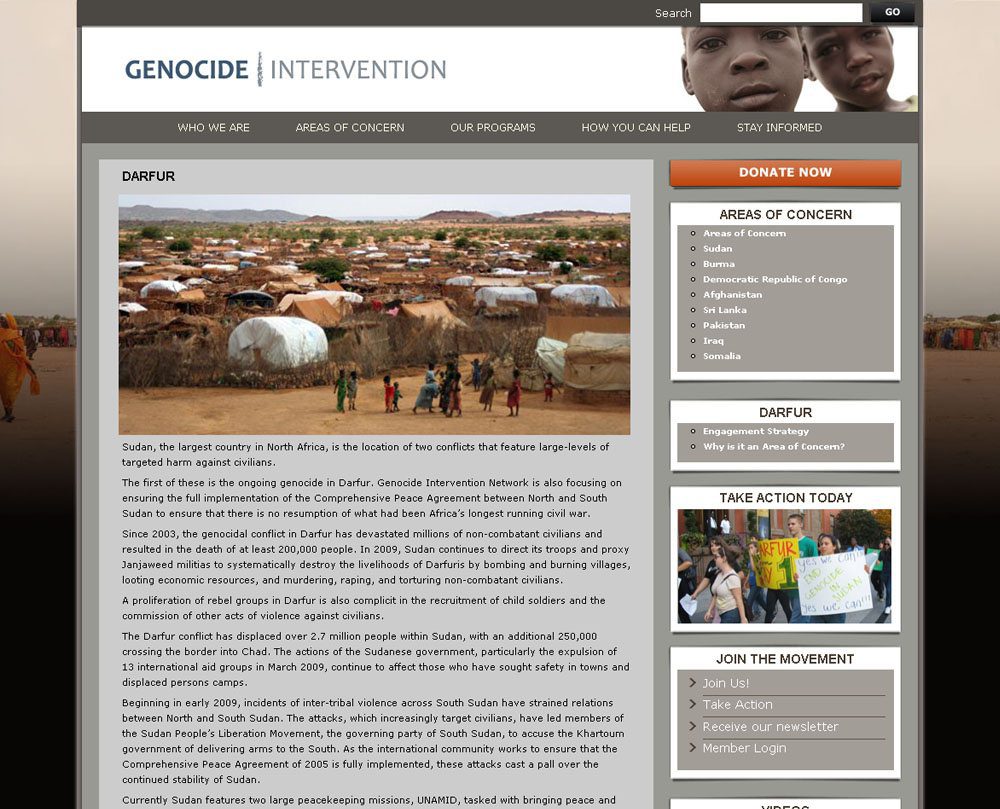
blueunderground [ web + design ] created a new brand for Genocide Intervention Network and designed and programmed the organization’s website using the Drupal content management system. The project included logo design, website design, front-end development, Drupal implementation, HTML, CSS, and supporting graphics prepared for a public-facing advocacy website.
Nonprofit Website Design for this kind of organization has to do more than look polished. It has to organize a complex mission, make programs understandable, guide visitors toward action, and support trust. The website needed to communicate the urgency of genocide prevention while remaining clear, structured, and accessible for a wide range of audiences.
Genocide Intervention Network’s mission was to empower individuals and communities with the tools to prevent and stop genocide. The organization described its work as building a permanent anti-genocide constituency committed to stopping the worst atrocities around the world. That mission required a website that could present advocacy, education, student organizing, fellowship work, civilian protection, conflict-risk engagement, and public policy initiatives in a format visitors could understand.
The completed website gave Genocide Intervention Network a stronger digital platform for its mission, programs, and public identity. It supported a serious cause with a professional brand system and a Drupal website that could help organize content for an expanding nonprofit advocacy network. As a Nonprofit Website Design project, the work connected visual identity, information architecture, and content management in one coordinated public platform.
Services Provided
Nonprofit Website Design Services Provided
- Brand identity design for a global anti-genocide organization
- Logo design for Genocide Intervention Network
- Nonprofit Website Design and Drupal website planning
- Website interface design for advocacy, education, and program content
- Drupal content management system setup and website development
- HTML and CSS front-end implementation
- Graphic design support for web presentation
- Content structure support for mission, programs, and organizational information
The original website was created with Adobe Photoshop, Adobe Illustrator, Drupal, HTML, and CSS. Those tools supported a larger design objective: creating a usable public website for a nonprofit organization with a complex mission and multiple audiences.
Nonprofit Website Design often requires a careful balance between emotional weight and practical clarity. Genocide Intervention Network addressed grave human-rights issues, but the website also had to give visitors clear ways to understand the organization, explore its programs, and see how ordinary people could become involved. The design needed to support education, advocacy, and trust without overwhelming the visitor.
The Drupal website gave the organization a structured content-management foundation. That was important because advocacy organizations often need to update program pages, publish news, maintain staff and leadership information, support campaign content, and keep educational resources organized. A content management system helps a nonprofit website remain useful as the organization’s work evolves. For this Nonprofit Website Design project, Drupal helped support the depth and structure required by a growing advocacy organization.
Nonprofit Website Design for a Global Advocacy Mission
Genocide Intervention Network worked on issues that were global in scope and urgent in tone. The organization’s public materials described a mission focused on empowering individuals and communities with tools to prevent and stop genocide. It also described a worldwide coalition of investors, a national fellowship of local leaders across the United States, and more than 1,000 student chapters at colleges and high schools.
That scope made the website more than a brochure. It needed to serve people entering the mission from different starting points. Some visitors may have been students looking for ways to organize. Some may have been donors or supporters looking for credibility. Some may have been policymakers, journalists, educators, or advocates looking for program information. Nonprofit Website Design had to help those audiences find a path through the organization’s work.
The site also had to support a serious tone. Human-rights advocacy can be weakened by design that feels too casual, too generic, or too difficult to navigate. A strong nonprofit website should help the organization look prepared, thoughtful, and capable. For Genocide Intervention Network, the website needed to communicate purpose without making the visitor work too hard to understand the mission.
blueunderground’s role was to translate that mission into a brand and website experience. The logo, layout, navigation, typography, content structure, and Drupal implementation all needed to work together. Nonprofit Website Design succeeds when the design supports the organization’s message rather than distracting from it.
Advocacy Website Design for Education and Action
Advocacy Website Design has a special responsibility because the website often becomes the bridge between awareness and action. A visitor may arrive with very little background on the issue. The website must help that person understand the stakes, learn what the organization does, and see meaningful ways to become involved.
Genocide Intervention Network’s work included education, organizing, and advocacy. Public resources connected the organization to genocide prevention, student activism, civilian protection, policy engagement, and programs designed to help people advocate in their communities. The website needed enough structure to organize that range of work without making the organization feel fragmented.
A nonprofit advocacy website should make programs visible and explainable. Nonprofit Website Design can help turn that program depth into a structure that visitors can understand. It should help visitors move from mission-level understanding to specific initiatives. It should also support credibility by showing that the organization has a defined role, a clear audience, and a purposeful approach. Nonprofit Website Design for Genocide Intervention Network therefore needed to support both storytelling and information architecture.
The website also needed to support action-oriented language. For organizations working around social justice, public policy, and human rights, the design cannot only present information. It has to help people see where they fit into the work. The Drupal site gave Genocide Intervention Network a platform for program content that could connect visitors to advocacy, education, and engagement.
Drupal Website Design for Nonprofit Content Management
The Genocide Intervention Network website was designed and programmed using Drupal. Drupal was a strong fit for a content-heavy nonprofit website because it could support structured pages, program content, navigation systems, and ongoing updates. For an advocacy organization, the ability to manage and grow content matters as much as the first visual design.
Drupal Website Design can be valuable for nonprofits that need more than a small static site. Organizations with many programs, campaigns, resources, public statements, staff pages, and advocacy sections benefit from a content-management system that can organize information clearly. For Genocide Intervention Network, the website needed to support both the public mission and the internal practical need to manage content.
Nonprofit Website Design and Drupal development worked together in this project. The design had to establish trust and clarity, while the CMS had to support the organization’s ability to maintain information. A successful nonprofit website should not become outdated immediately after launch because staff cannot manage it. The system should help the organization keep the public website useful.
The Drupal implementation also supported the seriousness of the project. In a Nonprofit Website Design context, the CMS needed to support credibility as well as practical content updates. Genocide Intervention Network’s work involved programs, initiatives, and educational materials. The website needed a framework that could accommodate that breadth while keeping the public experience coherent. That is why Nonprofit Website Design for a complex advocacy organization depends on both design clarity and content structure.
Nonprofit Logo Design and Brand Identity
The project also included logo design. Nonprofit Logo Design is important because a mission-based organization needs a mark that can work across many public settings. The logo may appear on the website, printed materials, presentations, advocacy documents, event graphics, partner materials, and outreach campaigns.
For Genocide Intervention Network, the brand identity needed to support a serious global mission. The logo and visual system had to feel credible, direct, and appropriate for an organization focused on genocide prevention and mass atrocity response. The identity could not feel decorative for its own sake. It needed to help the organization present itself with clarity and confidence.
Brand identity is especially important for organizations that rely on public trust. In Nonprofit Website Design, the visual identity and website structure should reinforce one another. A nonprofit may be asking people to donate, volunteer, advocate, learn, share information, organize others, or contact elected officials. A professional identity helps support those requests. Nonprofit Website Design becomes stronger when the brand, logo, content, and website structure feel like one coordinated system.
blueunderground’s brand and website work gave Genocide Intervention Network a public-facing identity that could support both mission communication and practical website use. The brand helped establish a visual foundation for the Drupal website and for the organization’s broader communications.
Content Structure for a Complex Nonprofit Organization
Genocide Intervention Network’s work touched many areas, including advocacy, student activism, civilian protection, public policy, fellowship programming, and conflict-risk engagement. A website for that kind of organization needs careful content structure. Visitors should not have to understand the organization’s internal program map before they can find useful information.
The website needed to make the mission visible while also giving individual programs enough room to be understood. Nonprofit Website Design helped organize that mission into a clearer public experience. A clear structure helps visitors move from broad overview to specific areas of interest. It also helps staff and supporters share links to relevant sections without requiring long explanations.
Nonprofit Website Design often succeeds or fails on this kind of structure. A visually attractive homepage is not enough if the programs are hard to find or the mission becomes buried. The Genocide Intervention Network site needed to support a serious topic while still giving visitors a usable path through the content.
Content organization also supports long-term maintenance. As a nonprofit adds programs, updates pages, changes priorities, or publishes new materials, a clear structure helps keep the website from becoming confusing. The Drupal CMS provided a foundation for that kind of ongoing management.
External Recognition and Public Context
Genocide Intervention Network’s public profile extended beyond its own website. The organization has been referenced by public media, universities, policy forums, and civic information resources. Those references help show why a strong website and brand identity mattered for the organization’s public presence.
Public descriptions of the organization emphasized its mission to empower individuals and communities with tools to prevent and stop genocide. The University of Notre Dame described Genocide Intervention Network as an organization whose members educate their communities, advocate for action from elected officials, and fundraise for civilian protection and human security. That public-facing mission reinforced the need for a website that could present the organization clearly and credibly.
The organization has also appeared in public affairs programming and civic resource listings, including C-SPAN organization references and events related to Darfur, social justice, and public advocacy. These external references show that Genocide Intervention Network operated within a broader public conversation about genocide prevention, Darfur, and civic action.
For a nonprofit with that kind of public role, the website is part of its credibility. Visitors may arrive after hearing about a lecture, media feature, student campaign, policy event, or advocacy program. Nonprofit Website Design helps make sure those visitors find a coherent identity and a clear explanation of the organization’s work.
Additional public references include Notre Dame News, the C-SPAN organization profile for Genocide Intervention Network, and the Genocide Intervention Network overview.
Nonprofit Website Design for Student and Community Engagement
One of the important public facts about Genocide Intervention Network was the breadth of its organizing network. The organization included more than 1,000 student chapters at colleges and high schools. It also included a national fellowship of local leaders across the United States and a worldwide coalition of investors.
That kind of network creates a wide range of website needs. Students may need to understand the mission quickly. Local leaders may need program details. Supporters may need to understand the organization’s credibility. Journalists or educators may need concise background. Donors may need confidence that the organization is organized and purposeful.
Nonprofit Website Design for this environment has to support many visitor paths. The site cannot assume that every visitor has the same background or the same goal. Good navigation, clear labels, program pages, and mission-focused writing help each audience orient itself.
For an organization working with student chapters and community advocates, the website also has to encourage participation. It should help visitors see that the mission is large but not distant. It should make action feel possible. The Drupal website gave Genocide Intervention Network a platform to organize that participation.
Designing for a Serious Human-Rights Mission
Designing for a human-rights organization requires care. The subject matter is serious, and the design should never make the mission feel superficial. At the same time, the website must remain usable. Visitors still need headings, navigation, program summaries, links, and readable pages.
For Genocide Intervention Network, Nonprofit Website Design needed to support gravity and clarity together. The brand and website had to respect the seriousness of genocide prevention while giving visitors a practical way to understand the organization’s work. That balance is part of the value of professional design.
A website for an anti-genocide organization should help people engage without becoming lost in complexity. It should support public education, program visibility, and organizational trust. It should also give staff a platform for ongoing updates, because advocacy work changes as events, programs, and campaigns evolve.
blueunderground’s work connected brand identity, website design, Drupal development, and content structure into a practical platform. The finished work supported Genocide Intervention Network’s mission with a stronger public-facing digital presence.
Long-Term Value of Nonprofit Website Design
Nonprofit Website Design creates long-term value when it helps an organization communicate clearly, organize information, and maintain trust over time. A website is often the first place people go to understand a mission. It is also where they return for updates, program information, resources, and contact details.
For Genocide Intervention Network, the website supported an organization that was building a permanent anti-genocide constituency. That work required public understanding, community organizing, and continued communication. A structured Drupal website helped create a foundation for those needs.
Long-term value also comes from the connection between brand and content. A clear logo, consistent design system, organized navigation, and usable CMS give a nonprofit more control over its public identity. Those elements help staff and supporters present the organization consistently across audiences.
View more blueunderground portfolio work for examples of design and website projects across different organizations.
For organizations with complex missions, strong design is not a luxury. It helps people understand the work. It gives programs a clear home. It supports credibility. It helps turn concern into engagement. Nonprofit Website Design can help make a serious mission easier to understand and easier to support.
Nonprofit Website Design and Public Trust
Nonprofit Website Design is also a trust-building tool. Visitors need to understand who the organization is, what it does, why the work matters, and how the website content is organized. When a nonprofit website presents that information clearly, the organization appears more prepared and more credible.
For Genocide Intervention Network, trust was especially important because the subject matter was urgent, global, and serious. The website needed to support advocates, students, donors, educators, partners, and public audiences without creating confusion. Nonprofit Website Design helped provide that organizing layer. Nonprofit Website Design helped turn a complex mission into a more usable public platform.
The same principle applies across mission-driven work. A strong nonprofit website should support the organization’s identity, explain its programs, and give visitors a clear path forward. Nonprofit Website Design helps make that possible by combining brand identity, content structure, visual clarity, and dependable website development.
About Genocide Intervention Network
About Genocide Intervention Network
Genocide Intervention Network’s mission was to empower individuals and communities with the tools to prevent and stop genocide. Established in 2005, the organization worked to mobilize a permanent anti-genocide constituency committed to stopping mass atrocities around the world.
The organization included a worldwide coalition of investors, a national fellowship of local leaders across the United States, and more than 1,000 student chapters at colleges and high schools. Its work focused on situations of genocide and mass atrocity, including systematic killing, severe torture, or rape of civilians on a mass scale.
Genocide Intervention Network was located in Washington, DC. Its work connected students, advocates, investors, fellows, community leaders, and public officials around the goal of preventing and stopping genocide. Public references also describe the organization’s role in Darfur advocacy, genocide-prevention education, and community-based organizing.
For blueunderground, the project was an example of how brand identity and website design can support a mission-driven organization with serious public responsibilities. The Genocide Intervention Network website needed to be clear, credible, and manageable, giving the organization a professional platform for its advocacy and education work.


![blueunderground [ web + design ]](https://blueunderground.com/wp-content/uploads/2023/12/blueunderground-logo-2023-footer.svg)

